

When evaluating a desktop 3D printer, the ideal choice depends entirely on the intended application. With TCT Asia 2026 approaching—recognized as the largest and most influential additive manufacturing event in the Asia-Pacific region—buyers have a critical opportunity to compare the latest technologies. The event will host more than 550 global exhibitors and expects over 40,000 professional visitors.
To help buyers navigate this complex market, we have categorized the desktop 3D printer landscape into two distinct scenarios: K-12/STEM Education and Professional Rapid Prototyping.
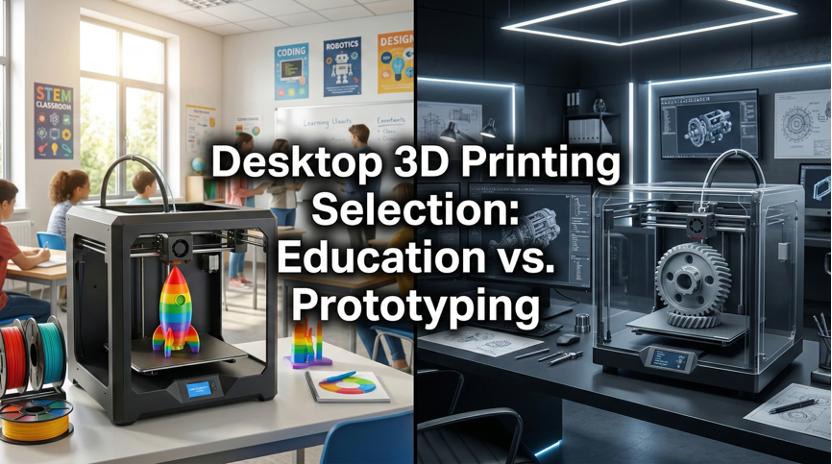
This matrix outlines the core requirements for our two primary user personas when selecting a desktop 3D printer.
Selection Parameter | Scenario A: STEM & Education | Scenario B: Professional Design Studio |
Primary Goal | Hands-on learning and safety | Iterative design and functional testing |
Key Capability | Fully enclosed design with HEPA/Carbon filtration | High-speed printing and dimensional accuracy |
Ideal Materials | PLA (Zero-VOC, biodegradable) | Engineering Materials (ABS, Nylon, PETG) |
Aesthetics | Single-color prints are sufficient | Multi-color (500,000+ combinations) |
Compliance | ANSI/CAN/UL 2904 standard for emissions | Fit/form validation against design specs |
The use of 3D printers for education has skyrocketed, with recent data showing that classroom usage tripled over a two-year period, and roughly half of US schools now house at least one device. For educators and IT administrators, the procurement criteria revolve strictly around student safety, ease of use, and low-maintenance materials.
1. Safety First: Enclosed Designs and Filtration
Safety is the paramount concern because desktop 3D printers can emit potentially harmful ultrafine particles (UFPs) and volatile organic compounds (VOCs).
2. Material Selection: The Importance of PLA
For K-12 environments, Polylactic acid (PLA) is the undisputed champion.
3. Ease of Use & Remote Management
Educators need to manage multiple students without creating a crowded hazard around the machine. Platforms that offer remote monitoring, like digital dashboard controls, allow teachers to manage print queues and lock user access from a single interface.
💡 TCT Asia 2026 Exhibitor Recommendations for Schools
If you are attending TCT Asia 2026 for a school recommendation, look for these classroom-safe models:
For engineers and designers, rapid prototyping is a critical methodology used to compress product development cycles and validate designs before committing to expensive mass-production tooling. The requirements here shift from basic safety to extreme performance, speed, and material versatility.
1. Speed and Production Throughput
In contract manufacturing and design studios, print speed directly impacts project economics.
2. Engineering-Grade Materials
Design validation requires materials that mimic final production parts.
3. Multi-Color & High-Fidelity Aesthetics
When presenting prototypes to stakeholders, visual realism is necessary to secure buy-in. Concurrent printing of multiple materials and textures in a single run eliminates the need for post-process painting. Advanced PolyJet technologies can reproduce over 500,000 color combinations with photorealistic accuracy.
💡 TCT Asia 2026 Exhibitor Recommendations for Professionals
For design studios seeking high-performance rapid prototyping tools, the following systems represent the cutting edge:
Choosing the right desktop 3D printer comes down to your primary environment: educators must prioritize enclosed safety and ease of use, while design studios require speed and advanced engineering materials. While comparing specifications is a great start, experiencing these machines firsthand is the best way to make a confident investment.
Ready to explore these solutions in person? Join over 40,000 professionals at TCT Asia 2026 (March 17-19, NECC Shanghai). Connect with 550+ global exhibitors to find the perfect 3D printing setup for your exact needs.
Pre-register now for TCT Asia 2026 to secure your visitor pass!
[1] https://store.creality.com/blogs/basics/3d-printing-in-schools
[2] https://www.stratasys.com/en/vivid-multicolor-prototyping/
[3] https://formlabs.com/blog/fastest-3d-printer/
[4] https://bambulab.com/en-us/x1e







TCT Asia