
TCT Asia 2026 (March 17–19, Shanghai NECC) confirmed that metal additive manufacturing has moved past the “can we print this” question. Across 550+ exhibitors and 55,000+ sqm in Hall 7.1 alone, the conversation had shifted from machine specs to production economics, application proof, and ecosystem partnerships.
Five stories captured that shift best:
Event Name: TCT Asia 2026
Dates: March 17–19, 2026
Venue: NECC (National Exhibition and Convention Center), Halls 7.1 & 8.1, Shanghai
Scale: 550+ exhibitors, 55,000+ sqm, 44,519 visitors (42% YoY growth)
If you missed TCT Asia 2026 — or want to see how these systems land with a South China / Greater Bay Area audience — TCT Shenzhen 2026 is the next major stop on the calendar.
Event Name: TCT Shenzhen 2026
Dates: October 14–16, 2026
Venue: Shenzhen World Exhibition & Convention Center, Hall 15
Register: reg-sz.tctasia.cn
| If you care about... | Look at |
|---|---|
| Large-format single-part production scaling toward 256 lasers | Eplus3D’s EP-M3050 preview |
| Aerospace propulsion / monolithic combustion chambers | LEAP 71 × HBD aerospike engine |
| AI-driven design meeting metal AM (hypersonic, defense-adjacent) | LEAP 71 × Farsoon precooler |
| Factory automation / digital production infrastructure | BLT × Siemens partnership |
| Pure copper, high-reflectivity metals, AI data center cooling | Addireen’s green-laser copper systems |
| Exhibitor(s) | What was shown | Key Spec / Detail | Best For |
|---|---|---|---|
| Eplus3D | EP-M3050 preview + Honor hinge cover production case | Up to 256 lasers, ~2,800mm casing printed in 316L | Super-sized aerospace structures + consumer electronics crossover |
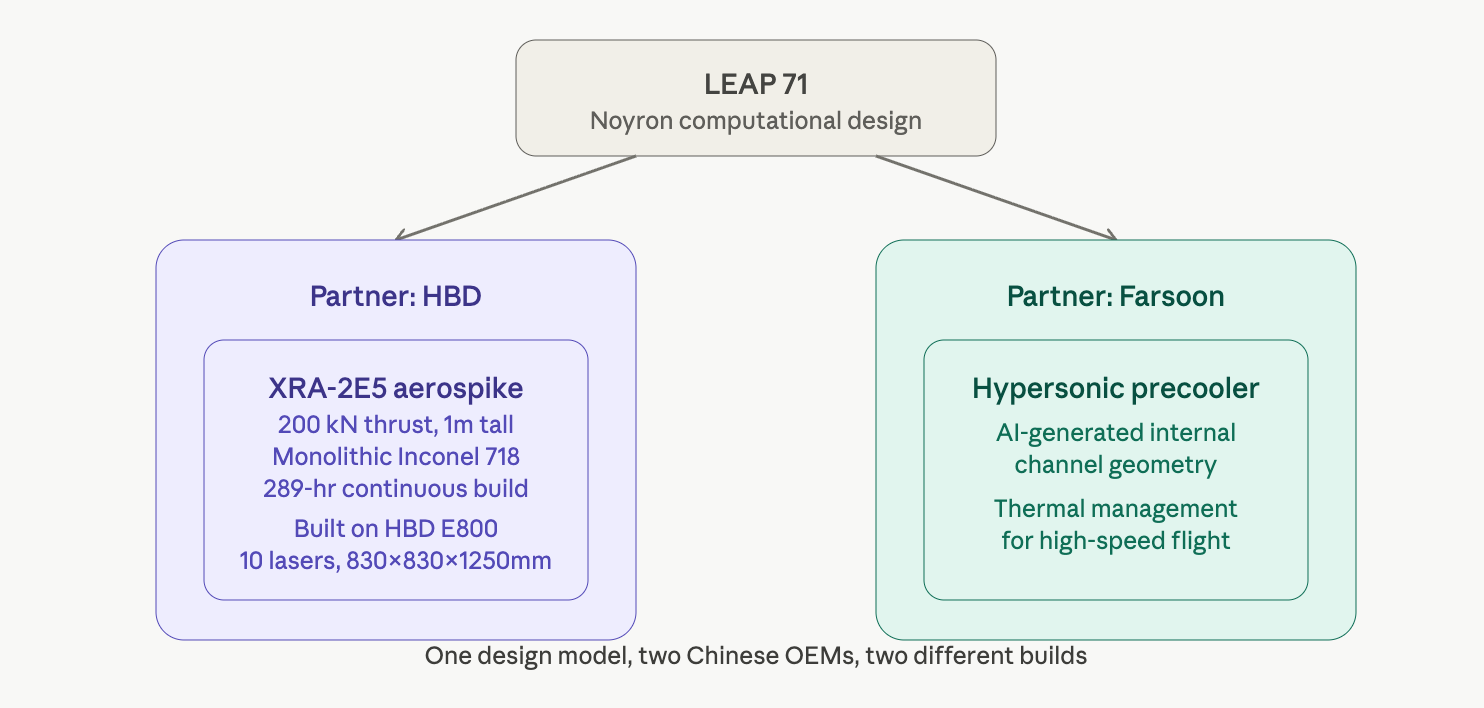
| LEAP 71 × HBD | XRA-2E5 aerospike rocket engine | 200 kN thrust, 1m tall, monolithic Inconel 718, 289-hour continuous build, printed on HBD’s E800 (10 lasers, 830×830×1250mm) | Monolithic rocket propulsion components |
| LEAP 71 × Farsoon | Hypersonic precooler | AI-generated (Noyron computational model) geometry, large-format metal PBF | Defense-adjacent thermal management, AI-designed parts |
| BLT × Siemens | Strategic Cooperation Agreement signed on-site | Focus: digital factories for AM, end-to-end process chain optimization | Manufacturers scaling AM into automated production environments |
| Addireen | Green-laser copper parts for AI liquid cold plates | 532nm green laser tech, ~10x copper absorption vs. infrared; flagship ADDIREEN 400G: 4 lasers, 400×400×400mm | Pure copper / high-reflectivity metals, AI server cooling |
Overview: Eplus3D used TCT Asia 2026 to preview its next-generation EP-M3050, a large-format system configurable with up to 256 lasers — a substantial jump from its existing EP-M2050 (36 lasers standard, 64 optional), which itself debuted at TCT Asia back in 2024. The headline demo piece was a roughly 2.8-meter casing printed in 316L stainless steel.
But the detail that actually moved the conversation forward wasn’t the laser count. During its presentation, Eplus3D pointed to a production case: titanium alloy hinge covers for Honor’s foldable phones, manufactured at volume. That’s a meaningfully different story from one-off aerospace demo parts — it signals metal AM entering consumer electronics supply chains, helped along by titanium powder costs in China falling from roughly 600 RMB/kg in 2023 to under 300 RMB/kg in 2024.
Strengths
Best for: Manufacturers planning multi-year capacity around large-format, multi-laser systems, and anyone tracking metal AM’s entry into high-volume consumer electronics.
Overview: This was the most-photographed object on the TCT Asia 2026 show floor. LEAP 71 (Dubai-based computational engineering company) and HBD (Shanghai-based metal AM manufacturer) 3D printed a one-meter-tall aerospike rocket engine, designated XRA-2E5, generating 200 kN (roughly 20 tons) of thrust. The engine was designed using LEAP 71’s Noyron computational engineering model and printed as a single monolithic part in Inconel 718 over a continuous 289-hour build, using HBD’s E800 system — a 10-laser machine with an 830×830×1250mm build volume.
Aerospike engines replace the conventional bell nozzle with a toroidal combustion chamber and central spike, theoretically maintaining efficiency across a wider range of atmospheric conditions — relevant for reusable launch vehicles that operate from sea level to vacuum. The geometry’s shallow overhangs and internal channels are notoriously difficult to produce by conventional means, which is exactly why a single-build additive approach mattered here.
Strengths
Best for: Commercial space companies and propulsion engineers evaluating whether large-format metal AM can replace multi-part assembly for next-generation rocket engines.
Overview: In a parallel collaboration, LEAP 71 worked with Farsoon to produce a hypersonic precooler — another Noyron-generated geometry, this time aimed at thermal management for high-speed flight systems. Where the HBD project showcased scale and propulsion, this project showcased precision thermal architecture: the kind of intricate, internally channeled geometry that’s effectively impossible to draw by hand but straightforward for a physics-driven computational model to generate.
Strengths
Best for: Teams exploring computational/AI-generated design workflows for thermal management parts that conventional CAD struggles to produce.
Overview: Rather than a new machine launch, BLT’s defining TCT Asia 2026 moment was a Strategic Cooperation Agreement signed on-site with Siemens, focused on building digital factories for additive manufacturing and optimizing the end-to-end production process chain. The signing — attended by BLT’s CEO Xue Lei and senior Siemens Digital Industries executives — builds on a partnership the two companies first established in 2023.
This follows BLT’s 2025 TCT Asia debut of BRIGHTENLINES, its automated production line integrating eight printers with powder circulation, material transfer, and waste recovery into a single manufacturing cell. The Siemens partnership reads as the next layer up: less about the physical line, more about the software and digital-twin infrastructure that ties multiple lines together.
Strengths
Best for: Manufacturers planning 24/7, multi-line automated metal AM production who want a roadmap toward integrated digital factory tooling, not just a single machine.
Overview: Shenzhen Addireen Technologies, a green-laser metal AM specialist founded in 2023 as a spinoff from laser manufacturer Shenzhen Gongda Laser, used TCT Asia 2026 to show parts printed in pure copper and other highly reflective metals — with a notably current application: monolithic designs for AI server liquid cold plates. Addireen’s approach uses 532nm green lasers instead of standard infrared, which copper absorbs far more efficiently — roughly 10x the absorption rate, according to the company — avoiding the spatter and optics damage that plague infrared-based copper printing.
Addireen’s flagship system, the ADDIREEN 400G, runs four synchronized green lasers across a 400×400×400mm build volume, with parts achieving 99.8%+ density, ~101% IACS electrical conductivity, and minimum wall thickness down to 0.08mm.
Strengths
Best for: Manufacturers needing monolithic, high-reflectivity-metal parts (copper, precious metals) for thermal management in EVs, data centers, or aerospace — not for buyers chasing maximum build envelope.
Build volume and laser count are no longer the differentiator. As one show report put it, the era of competing on specs alone is over. If you’re evaluating systems based purely on a comparison table, you’re asking last year’s question — production economics, automation, and application proof now matter more.
Demonstrator parts ≠ shipping products. Both the rocket engine and the precooler were computational-design showcases. Genuinely useful for understanding where the technology is headed, but not yet representative of what you’d be buying off a price list today.
Watch the partnerships, not just the machines. BLT’s Siemens agreement and the recurring LEAP 71 collaborations (with HBD, Farsoon, and previously SLM Solutions) suggest the next competitive axis is ecosystem integration — software, digital twins, computational design tools — not raw hardware specs.
Application specificity is the new selling point. Eplus3D’s hinge covers and Addireen’s AI cooling plates both point to the same trend: vendors increasingly lead with “here’s the exact production problem this solves” rather than “here’s how big our machine is.”
Geographic and cost context matters. Falling Chinese titanium powder prices (down roughly half from 2023 to 2024) are quietly doing as much to expand metal AM’s addressable market as any laser upgrade.
The common thread across TCT Asia 2026’s top metal AM stories wasn’t a single “best” system — it was a visible shift from machine-centric to application- and ecosystem-centric competition. Eplus3D and the LEAP 71 collaborations pushed the limits of what can be printed in one piece; BLT’s Siemens partnership pushed the limits of what can be automated and integrated; Addireen pushed a niche material capability into a genuinely current application. For buyers, the more useful question isn’t “which machine is biggest” but “which of these stories matches the production problem I’m actually trying to solve.”
The LEAP 71 × HBD aerospike rocket engine — a 200 kN, one-meter-tall engine printed as a single monolithic Inconel 718 part over a continuous 289-hour build — drew the most attention on the show floor.
Yes, using green laser technology (typically 515–532nm) rather than standard infrared. Companies like Addireen, BLT, and Germany’s Trumpf all offer green-laser systems that achieve significantly higher copper absorption than infrared lasers, avoiding the spatter and optics damage that copper otherwise causes.
Yes — Eplus3D presented titanium alloy hinge covers for Honor foldable smartphones as a production case study at TCT Asia 2026, and BLT has previously detailed similar work on foldable-phone hinges for other Chinese consumer electronics brands.
Eplus3D previewed its EP-M3050, configurable with up to 256 lasers and capable of printing parts roughly 2.8 meters in scale, though this was shown as a preview rather than a shipping system.
TCT Shenzhen 2026 runs October 14–16, 2026, at the Shenzhen World Exhibition & Convention Center, Hall 15.
Sources







TCT Asia